Establishment theoretical framework as the standard theory of electroweak interactions: Higgs searches, quark mixing, neutrino oscillations.
{% include list.liquid all=true %}
Gauge invariance is a powerful tool to determine the dynamical forces. Particle content, structure and symmetries of Lagrangian are discussed.
Electroweak force is the unified description of two (2) fundamental interactions: electromagnetism (electromagnetic interaction) and the weak interaction.
***The Higgs and the electromagnetic field have no effect on each other***, at the level of the fundamental forces ("tree level"), while any other combination of the hypercharge and the weak isospin must interact with the Higgs. ***This causes an apparent separation between the weak force, which interacts with the Higgs, and electromagnetism, which does not***. _([Wikipedia](https://en.wikipedia.org/wiki/Electroweak_interaction#Formulation))_

Thus, if the temperature is high enough – approximately 10¹⁵ K – then the electromagnetic force and weak force merge into a combined electroweak force.

- This diagram illustrates a triple gauge boson vertex involving two W bosons (\(W^{-}\)) and a neutral gauge boson (\(Z\) or \(\gamma \)).
- The wavy lines represent the propagation of the gauge bosons, with arrows indicating the flow of charge or momentum.
- The central dot signifies a vertex, a specific point in spacetime where these particles interact according to the laws of electroweak theory.

After electroweak mixing, they would combine to form the photon and the Z boson while the gluons remain separate and continue to mediate color-changing interactions among quarks.

This section depicts Right-handed fermions, a classification of particles in the Standard Model that do not participate in the weak interaction.

Experiments have verified that the weak and electromagnetic force become identical at very small distances and provide the GUT description of the carrier particles for the forces.

You can use this comprehensive reference to configure any pairlist method with all available parameters!


Electroweak theory added ψνe,ψνμ,nu mu e, and ψντ for the corresponding [neutrinos](https://en.wikipedia.org/wiki/Neutrino).
- The [quarks](https://en.wikipedia.org/wiki/Quark) add still further components.
- In order to be [four-spinors](https://en.wikipedia.org/wiki/Dirac_spinor#Four-spinor_for_particles) like the electron and other [lepton](https://en.wikipedia.org/wiki/Lepton) components, there must be one quark component for every combination of [flavor](https://en.wikipedia.org/wiki/Flavour_(particle_physics)) and [color](https://en.wikipedia.org/wiki/Color_charge), **bringing the total to 24 (3 for charged leptons, 3 for neutrinos, and 2·3·3 = 18 for quarks)**.

Each of these is a four component [bispinor](https://en.wikipedia.org/wiki/Bispinor), **for a total of 96 complex-valued components** for the fermion field. _[Wikipedia](https://en.wikipedia.org/wiki/Mathematical_formulation_of_the_Standard_Model)_
  Fermion  | spinors | charged | neutrinos |   quark   | components | parameter
   Field   |   (s)   |   (c)   |    (n)    | (q=s.c.n) |  Σ(c+n+q   | (complex)
===========+=========+=========+===========+===========+============+===========
boson-1    |    ..   |    ..   |     ..    |     ..    |      5     |    i5
-----------+---------+---------+-----------+-----------+------------+-----------
boson-2    |    ..   |    ..   |     ..    |     ..    |      7     |    i7
-----------+---------+---------+-----------+-----------+------------+-----------
boson-3    |    ..   |    ..   |     ..    |     ..    |     11     |   i11
-----------+---------+---------+-----------+-----------+------------+-----------
boson-4    |    ..   |    ..   |     ..    |     ..    |     13     |   i13
-----------+---------+---------+-----------+-----------+------------+-----------
boson-5    |    ..   |    ..   |     ..    |     ..    |     17     |   i17
===========+=========+=========+===========+===========+============+===========
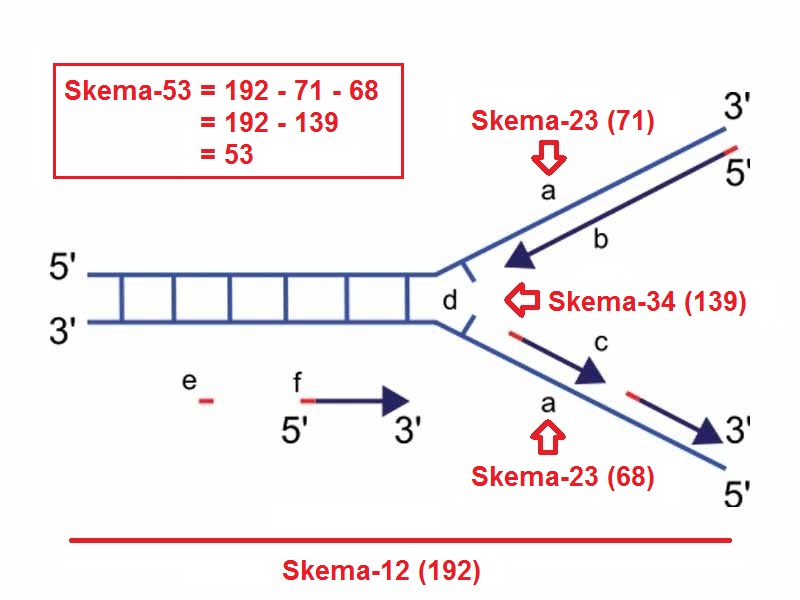
  SubTotal |    ..   |    ..   |     ..    |     ..    |     53     |   i53
===========+=========+=========+===========+===========+============+===========
bispinor-1 |    2    |    3    |     3     |    18     |     24     |   19
-----------+---------+---------+-----------+-----------+------------+-- 17
bispinor-2 |    2    |    3    |     3     |    18     |     24     |   i12
===========+=========+=========+===========+===========+============+===========
bispinor-3 |    2    |    3    |     3     |    18     |     24     |   11
-----------+---------+---------+-----------+-----------+------------+-- 19
bispinor-4 |    2    |    3    |     3     |    18     |     24     |   i18
===========+=========+=========+===========+===========+============+===========
  SubTotal |    8    |   12    |    12     |    72     |     96     |  66+i30
===========+=========+=========+===========+===========+============+===========
majorana-1 |   2x2   |    -    |    18     |     -     |     18     |   18
-----------+---------+---------+-----------+-----------+------------+-----------
majorana-2 |   2x2   |    -    |    12     |     -     |     12     |   12
-----------+---------+---------+-----------+-----------+------------+-----------
majorana-3 |   2x2   |    -    |    13     |     -     |     13     |   i13
===========+=========+=========+===========+===========+============+===========
  SubTotal |    12   |    -    |    43     |     -     |     43     |  30+i13
===========+=========+=========+===========+===========+============+===========
     Total |    20   |   12    |    55     |    72     |    192     |  96+i96 ✔️


The pattern of [weak isospin](https://en.wikipedia.org/wiki/Weak_isospin), T3, and [weak hypercharge](https://en.wikipedia.org/wiki/Weak_hypercharge), YW, of the known elementary particles, showing electric charge along the [weak mixing angle](https://en.wikipedia.org/wiki/Weinberg_angle). The four components of the Higgs field (squares) break the electroweak symmetry and interact with other particles to give them mass, with three components becoming part of the massive W and Z bosons. Allowed decays of the neutral Higgs boson, H, (circled) satisfy electroweak charge conservation. _([Wikipedia](https://en.wikipedia.org/wiki/Electroweak_interaction))_

The Lagrangian for the electroweak interactions is divided into four parts before electroweak symmetry breaking becomes manifest,
$True Prime Pairs:
(5,7$True Prime Pairs:
(5,7), (11,13), (17,19)

     |    168    |    618    |
-----+-----+-----+-----+-----+                                             ---
 19¨ |  3¨ |  4¨ |  6¨ |  6¨ | 4¤  ----->  assigned to "id:30"             19¨
-----+-----+-----+-----+-----+                                             ---
 17¨ | {5¨}| {3¨}|  2¨ |  7¨ | 4¤  ----->  assigned to "id:31"              |
     +-----+-----+-----+-----+                                              |
{12¨}|  6¨ |  6¨ |  2¤ (M & F)     ----->  assigned to "id:32"              |
     +-----+-----+-----+                                                    |
 11¨ |  3¨ | {3¨}| {5¨}| 3¤  --->  Np(33)  assigned to "id:33"  ----->  👉 77¨
-----+-----+-----+-----+-----+                                              |
 19¨ |  4¨ |  4¨ |  ❓ |  ❓ | 4¤ ✔️ --->  assigned to "id:34"              |
     +-----+-----+-----+-----+                                              |
{18¨}|  .. |  .. |  .. | 3¤        ----->  assigned to "id:35"              |
     +-----+-----+-----+-----+-----+-----+-----+-----+-----+               ---
 43¨ |  .. |  .. |  .. |  .. |  .. |  .. |  .. |  .. |  .. | 9¤ (C1 & C2)  43¨
-----+-----+-----+-----+-----+-----+-----+-----+-----+-----+               ---
139¨ |  1     2     3  |  4     5     6  |  7     8     9  |
                    Δ                 Δ                 Δ
Here's a comprehensive summary of **all parameters for each pairlist method**:
## Freqtrade Pairlist Methods - Complete Parameters
### **Generators** (create initial pairlists)
#### 1. **StaticPairList**
- `allow_inactive` (boolean): Skip pair validation against active markets (optional)
#### 2. **VolumePairList**
- `number_assets` (number, required): Number of top pairs to select
- `sort_key` (string, default: "quoteVolume"): Sort key for sorting
- `min_value` (number, default: 0): Minimum volume threshold
- `max_value` (number, default: None): Maximum volume threshold
- `refresh_period` (number, default: 1800): Refresh interval in seconds
- `lookback_days` (number, default: 0): Days to look back (for advanced mode)
- `lookback_timeframe` (string, default: ""): Timeframe for lookback
- `lookback_period` (number, default: 0): Number of periods to look back
#### 3. **PercentChangePairList**
- `number_assets` (number): Top pairs to select by % change
- `min_value` (number): Minimum % change threshold
- `max_value` (number): Maximum % change threshold
- `sort_direction` (string): "asc" or "desc" for sort order
- `refresh_period` (number, default: 1800): Refresh interval in seconds
- `lookback_days` (number): Days to look back
- `lookback_timeframe` (string): Timeframe for lookback
- `lookback_period` (number): Number of periods
#### 4. **ProducerPairList**
- `number_assets` (number, optional): Limit pairlist length
- `producer_name` (string, required): Name of the producer
#### 5. **RemotePairList**
- `pairlist_url` (string, required): Remote server URL or file path
- `mode` (string, default: "whitelist"): "whitelist" or "blacklist"
- `processing_mode` (string, default: "filter"): "filter" or "append"
- `number_assets` (number, optional): Number of pairs to return
- `refresh_period` (number, default: 1800): Refresh interval in seconds
- `keep_pairlist_on_failure` (boolean, default: true): Keep last pairlist on failure
- `read_timeout` (number, default: 60): Read timeout in seconds
- `bearer_token` (string, optional): Bearer token for auth
- `save_to_file` (string, optional): Save pairlist to file
#### 6. **MarketCapPairList**
- `number_assets` (number): Maximum pairs to return in whitelist mode
- `max_rank` (number): Maximum marketcap rank to consider
- `refresh_period` (number, default: 86400): Refresh interval in seconds
- `mode` (string, default: "whitelist"): "whitelist" or "blacklist"
- `categories` (array, default: []): CoinGecko category IDs to filter
#### 7. **CrossMarketPairList**
- `pairs_exist_on` (string, default: "both_markets"): "both_markets" or "current_market_only"
---
### **Filters** (refine existing pairlists)
#### 8. **AgeFilter**
- `min_days_listed` (number, default: 10): Minimum days pair must be listed
- `max_days_listed` (number, default: None): Maximum days pair can be listed
#### 9. **DelistFilter**
- `max_days_from_now` (number, default: 0): Maximum days until delisting
#### 10. **FullTradesFilter**
- No parameters
#### 11. **OffsetFilter**
- `offset` (number, required): Number of pairs to skip
- `number_assets` (number, optional): Number of pairs to take
#### 12. **PairInformationFilter**
- `selection_mode` (string): "whitelist" or "blacklist"
- `info_key` (string): Field to check (supports dot notation for nested fields)
- `info_compare_value` (string): Value to match
#### 13. **PerformanceFilter**
- `minutes` (number, default: 0): Rolling window in minutes (0 = all-time)
- `min_profit` (number, optional): Minimum profit ratio (e.g., 0.01 = 1%)
#### 14. **PrecisionFilter**
- No parameters
#### 15. **PriceFilter**
- `min_price` (number, default: 0): Minimum price threshold
- `max_price` (number, default: 0): Maximum price threshold
- `max_value` (number, optional): Maximum minimum value change
- `low_price_ratio` (number, default: 0): Filter low-priced pairs by ratio
#### 16. **RangeStabilityFilter**
- `lookback_days` (number): Days to look back
- `min_rate_of_change` (number): Minimum rate of change (0.01 = 1%)
- `max_rate_of_change` (number): Maximum rate of change (0.99 = 99%)
- `refresh_period` (number, default: 86400): Refresh interval in seconds
- `sort_direction` (string, optional): "asc" or "desc"
#### 17. **ShuffleFilter**
- `seed` (number, optional): Random seed for reproducibility
- `shuffle_frequency` (string, default: "candle"): "candle" or "iteration"
#### 18. **SpreadFilter**
- `max_spread_ratio` (number, default: 0.005): Maximum bid/ask spread ratio
#### 19. **VolatilityFilter**
- `lookback_days` (number): Days to look back
- `min_volatility` (number): Minimum volatility threshold
- `max_volatility` (number): Maximum volatility threshold
- `refresh_period` (number, default: 86400): Refresh interval in seconds
- `sort_direction` (string, optional): "asc" or "desc"
$True Prime Pairs:
(5,7$True Prime Pairs:
(5,7), (11,13), (17,19)

     |    168    |    618    |
-----+-----+-----+-----+-----+                                             ---
 19¨ |  3¨ |  4¨ |  6¨ |  6¨ | 4¤  ----->  assigned to "id:30"             19¨
-----+-----+-----+-----+-----+                                             ---
 17¨ | {5¨}| {3¨}|  2¨ |  7¨ | 4¤  ----->  assigned to "id:31"              |
     +-----+-----+-----+-----+                                              |
{12¨}|  6¨ |  6¨ |  2¤ (M & F)     ----->  assigned to "id:32"              |
     +-----+-----+-----+                                                    |
 11¨ |  3¨ | {3¨}| {5¨}| 3¤  --->  Np(33)  assigned to "id:33"  ----->  👉 77¨
-----+-----+-----+----+-----+                                              |
 19¨ |  4¨ |  4¨ |  5¨ |  6¨ | 4¤ ✔️ --->  assigned to "id:34"              |
     +-----+-----+-----+-----+                                              |
{18¨}|  .. |  .. |  .. | 3¤        ----->  assigned to "id:35"              |
     +-----+-----+-----+-----+-----+-----+-----+-----+-----+               ---
 43¨ |  .. |  .. |  .. |  .. |  .. |  .. |  .. |  .. |  .. | 9¤ (C1 & C2)  43¨
-----+-----+-----+-----+-----+-----+-----+-----+-----+-----+               ---
139¨ |  1     2     3  |  4     5     6  |  7     8     9  |
Δ Δ Δ 
Consider the following contradiction in the electroweak theory of the Standard Model.

The electroweak theory of neutrino interaction uses factors like  in order to account for a complete parity violation. This factor implies a massless neutrino [1]: “Nature had the choice of an aesthetically satisfying, but a left-right, symmetry violating theory, with a neutrino which travels exactly with the same velocity of light; or alternatively a theory where left-right symmetry is preserved, but the neutrino has a tiny mass – some ten thousand times smaller than the mass of the electron.”
The neutrino masslessness is also stated by other authors. A review article on neutrino properties states that “two-components left-handed massless neutrino fields play a crucial role in the determination of the charged current structure of the Standard Model” (see the Abstract of [2]). Similarly, a Quantum Field Theory textbook states: “Thus, massless neutrinos are a prediction of the Standard Model” (see [4], p. 555). Indeed, a massless neutrino is the basis for the two-component Weyl neutrino, which shows parity violation (see e.g. section 2.2 of [2]). The same argument appears on p. 139 of [3].

On the other hand, a recent review article negates the foregoing ides and states that it is now admitted “that neutrinos can no longer be considered as massless particles” (see [5], p. 1307). This statement is adopted by the Particle Data Group [6], which is the authorized organization for the definition of reliable particle data. The recognition of this fact by the community was demonstrated by the 2015 Nobel Prize, awarded to the persons who have discovered this property [7].
It follows that the experimentally confirmed massive neutrino undermines the basis of the Standard Model electroweak theory, since the massless neutrino is a crucial element in this theory.

Research topic: Can the validity of the electroweak theory be restored?

Remark: Further  contradictions are discussed in [8]. _([Research Topics](https://oprassn.org/a-problem-in-the-electroweak-theory/))_

The True Prime Pairs
(5,7), (11,13), (17,19)

Tabulate Prime by Power of 10
loop(10) = π(10)-π(1) = 4-0 = 4
loop(100) = π(100)-π(10)-1th = 25-4-2 = 19
loop(1000) = π(1000) - π(100) - 10th = 168-25-29 = 114

--------------------------+----+----+----+----+----+----+----+----+----+-----
 True Prime Pairs → Δ→π  |  1 |  2 |  3 |  4 |  5 |  6 |  7 |  8 |  9 | Sum
==========================+====+====+====+====+====+====+====+====+====+=====
 19 → π(∆10) → π(10)     |  2 |  3 |  5 |  7 |  - |  - |  - |  - |  - | 4th  4 x Root
--------------------------+----+----+----+----+----+----+----+----+----+-----
 17 → π(10+∆9) → π(19)   | 11 | 13 | 17 | 19 |  - |  - |  - |  - |  - | 8th  4 x Twin
==========================+====+====+====+====+====+====+====+====+====+===== 1st Twin
 13 → π(19+∆10) → π(29)  | 23 | 29 |  - |  - |  - |  - |  - |  - |  - |10th
--------------------------+----+----+----+----+----+----+----+----+----+-----
 11 → π(29+∆12) → π(41)  | 31 | 37 | 41 |  - |  - |  - |  - |  - |  - |13th
==========================+====+====+====+====+====+====+====+====+====+===== 1st Twin
  7 → π(41+∆18) → π(59)  | 43 | 47 | 53 | 59 |  - |  - |  - |  - |  - |17th
--------------------------+----+----+----+----+----+----+----+----+----+----- 3rd Twin
  5 → π(59+∆13) → π(72)  | 61 | 67 | 71 |  - |  - |  - |  - |  - |  - |20th
==========================+====+====+====+====+====+====+====+====+====+===== 4th Twin
  3,2 → 18+13+12 → 43    | 73 | 79 | 83 | 89 | 97 | 101| 103| 107| 109|29th
==========================+====+====+====+====+====+====+====+====+====+=====
         Δ                                                            Δ
12+13+(18+18)+13+12   ← 36th-Δ1=151-1=150=100+2x(13+12)   ←   30th = 113 = 114-
How do you resolve Maxwell equations as euler-lagrange equation without electromagnetic electromagnetism, lagrangian formalism, field theory, Maxwell equations, variational principle potential.
Axial (e-e rES repulsions blue aggregating to black axial outward, vs weak axial inward) to generate the Bose “cylinder surface” proof of statistical mechanics.
- Axial View of one hemisphere set of one subshell (N,1,many,-1/2) quantum number example below:
- That gives the path from Planck strength to the Maxwell strengths. Those are not independent, but all based upon h (or h-hat*c version in this case).
- Yes, I used Euler to get there! The weakness of the Lagrangian is that introduces errors in (a0/re)N scaling ^2 vs ^3 (extra 1/r wrongly called angular momentum by Bohr) that introduces an error correction. Hence, circling back to QED methods of error-correction (loops, re-normalization).

So, in the end, you do need. But the path can get similar when you move off arbitration x,y,z or X1,X2,X3 frame-of-reference to the quantitized hemispherical coordinates of the quantum numbers understood as (r#,theta#,phi#,z#).


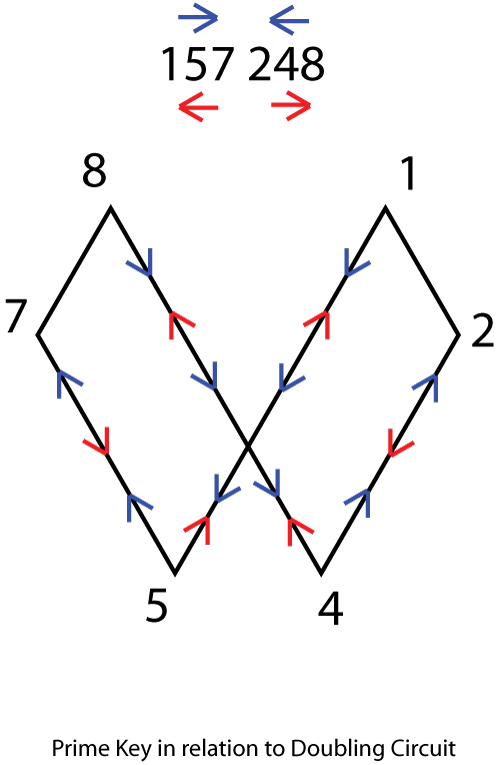
1729 = 7 x 13 x 19
1729 / 7 = 13 x 19 = 247

1729 = 7 x 13 x 19
       7 + 13 = 20 = d(2)
                     └──  2 x 19 = 38

+----+----+----+----+----+----+----+----+----+----+----+----+----+----+
| {1}|  2 |  3 |  4 |  5 | {6}| {7}|  8 |  9 | 10 | 11 | 12 | 13 | 14 |
+----+----+----+----+----+----+----+----+----+----+----+----+----+----+
| {3}| {4}|  3 |  4 |  5 |  2 |  3 |  2 |  2 |  1 |  2 |  5 |  1 |  1 |{38}
+----+----+----+----+----+----+----+----+----+----+----+----+----+----+---- } 285
|  3 |  8 |  9 | 16 | 25 |{12}|{21}| 16 | 18 | 10 | 22 | 60 |{13}|{14}|{247}
+----+----+----+----+----+----+----+----+----+----+----+----+----+----+
|-- 38 ---|              |-- 33 ---|                        |-- {27}--|
The lack of detection of proton decay (in any form) brings into question the veracity of SU(5) GUTs of all types; however, while the models are highly constrained by this result, they are not in general ruled out.

$True Prime Pairs:
(5,7$True Prime Pairs:
(5,7$True Prime Pairs:
(5,7), (11,13), (17,19)

     |    168    |    618    |
-----+-----+-----+-----+-----+                                             ---
 19¨ |  3¨ |  4¨ |  6¨ |  6¨ | 4¤  ----->  assigned to "id:30"             19¨
-----+-----+-----+-----+-----+                                             ---
 17¨ | {5¨}| {3¨}|  2¨ |  7¨ | 4¤  ----->  assigned to "id:31"              |
     +-----+-----+-----+-----+                                              |
{12¨}|  6¨ |  6¨ |  2¤ (M & F)     ----->  assigned to "id:32"              |
     +-----+-----+-----+                                                    |
 11¨ |  3¨ | {3¨}| {5¨}| 3¤  --->  Np(33)  assigned to "id:33"  ----->  👉 77¨
-----+-----+-----+-----+-----+                                              |
 19¨ |  4¨ |  4¨ |  5¨ |  6¨ | 4¤ ✔️ --->  assigned to "id:34"              |
     +-----+-----+-----+-----+                                              |
{18¨}|  .. |  .. |  .. | 3¤        ----->  assigned to "id:35"              |
     +-----+-----+-----+-----+-----+-----+-----+-----+-----+               ---
 43¨ |  .. |  .. |  .. |  .. |  .. |  .. |  .. |  .. |  .. | 9¤ (C1 & C2)  43¨
-----+-----+-----+-----+-----+-----+-----+-----+-----+-----+               ---
139¨ |  1     2     3  |  4     5     6  |  7     8     9  |
                    Δ                 Δ                 Δ
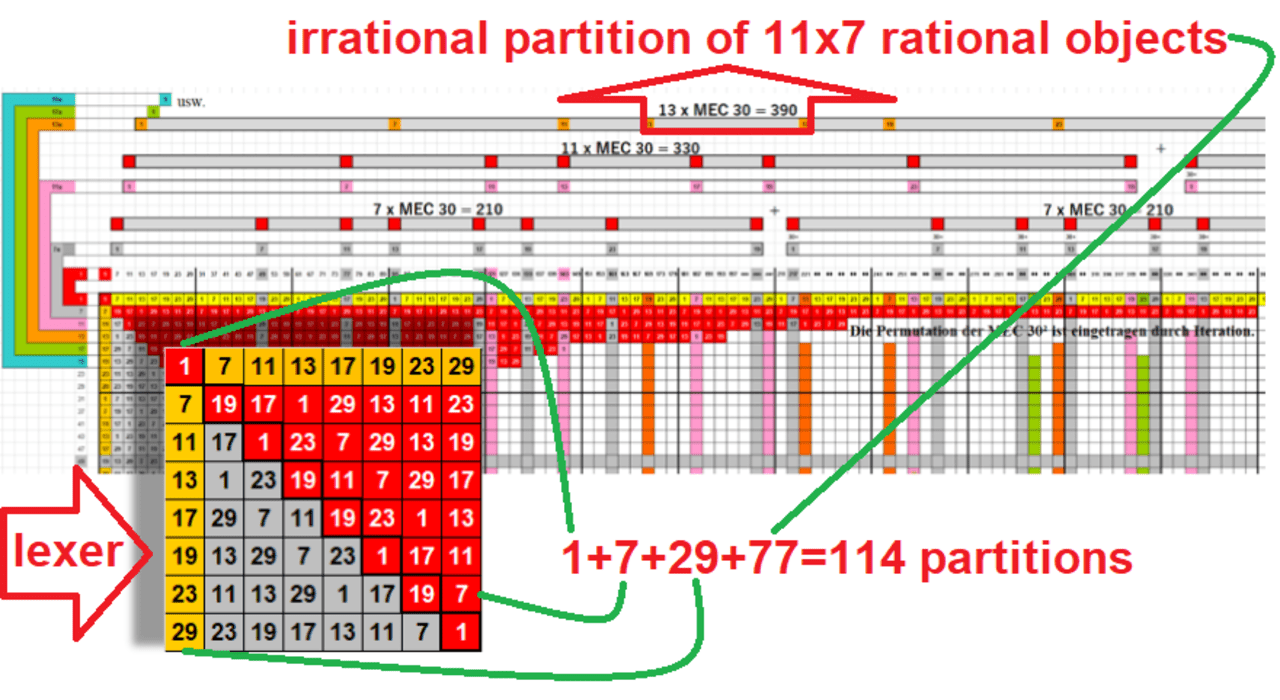
1 instance + 7 blocks + 29 flats + 77 rooms = 114 objects
Prime Loops:
π(10) = 4 (node)
π(100) = 25 (partition)
π(1000) - 29 = 139 (section)
π(10000) - 29th - 29 = 1091 (segment)
π(100000) - 109th - 109 = 8884 (texture)
Sum: 4 + 25 + 139 + 1091 + 8884 = 10143 (object)

Sequence Layers:
- By the next layer the 89² will become 89 and 5 become 5² or 25.
- This 89 and 25 are in the same layer with total of 114 or prime 619
- So sequence from the first prime is 1,4,7,10,29,68,89,114,139,168,329,618.

     |    168    |    618    |
-----+-----+-----+-----+-----+     -----------------------------------------------
{786}| 1,2 |  2  | 2,3 | 3,4 | {19}                                          |
-----+-----+-----+-----+-----+                                               |
 {86}|  4  | 4,5 | 5,6 |{6,7}| 17                                        Base Zone
     +-----+-----+-----+-----+                                               |
 {78}|{7,8}| 8,9 | 12 (M dan F) ----> Δ                                      |
     +-----+-----+-----+                                               -----------
 {67}| 9,11|11,12|12,14| 11 <----------- Mid Zone                            |
 ----+-----+-----+-----+-----+                                               |
  {6}|15,16|17,18|18,20|21,22| 19                                      Mirror Zone
     +-----+-----+-----+-----+                                               |
  {8}|23,25|25,27|27,29| 18                                                  |
     +-----+-----+-----+-----+-----+-----+-----+-----+-------+         -----------
  {7}|29,33|33,36|36,39|39,41|41,45|46,51|51,57|58,66|{67,77}| 43 (C1 dan C2)<---Δ
-----+-----+-----+-----+-----+-----+-----+-----+-----+-------+         -----------
     |  1     2     3  |   4     5     6 |   7     8      9  |
     |------ 29' ------|--------------- 139' ----------------|
     |------ 102¨ -----|---------------  66¨ ----------------|

Scheme 13:9
===========
(1){1}-7:   7'
(1){8}-13:  6‘
(1)14-{19}: 6‘
------------- 6+6 -------
(2)20-24:   5'           |
(2)25-{29}: 5'           |
------------  5+5 -------
(3)30-36:   7:{70,30,10²}|
------------             |
(4)37-48:   12• ---      |
(5)49-59:   11°    |     |
            --}30° 30•   |
(6)60-78:   19°    |     |
(7)79-96:   18• ---      |
--------------           |
(8)97-109:  13           |
(9)110-139:{30}=5x6 <--x-
            --
           {43}
The True Prime Pairs:
(5,7), (11,13), (17,19)

|-------------------------------- 2x96 -------------------------------|
|--------------- 7¤ ---------------|------------ 7¤ ------------------|
|-------------- {89} --------------|{12}|-- {30} -|-- {36} -|-- {25} -|
+----+----+----+----+----+----+----+----+----+----+----+----+----+----+
|  5 |  7 | 11 |{13}| 17 | 19 | 17 |{12}| 11 | 19 | 18 | 18 | 12 | 13 |
+----+----+----+----+----+----+----+----+----+----+----+----+----+----+
|--------- {53} ---------|---- {48} ----|---- {48} ----|---- {43} ----|
|---------- 5¤ ----------|------------ {96} -----------|----- 3¤ -----|
|-------- Bosons --------|---------- Fermions ---------|-- Gravitons--|
13 variations 48 variations 11 variations 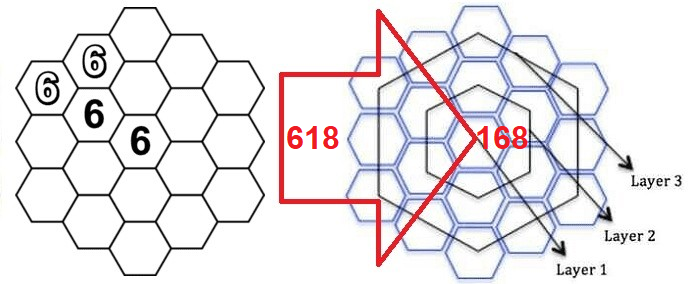
The Prime Recycling ζ(s):
(2,3), (29,89), (36,68), (72,42), (100,50), (2,3), (29,89), ...**infinity**

----------------------+-----+-----+-----+                                    ---
     7 --------- 1,2:1|   1 |  30 |  40 | 71 (2,3) ‹-------------@----        |
     |                +-----+-----+-----+-----+                        |      |
     |  8 ‹------  3:2|   1 |  30 |  40 |  90 | 161 (7) ‹---           |      5¨  encapsulation
     |  |             +-----+-----+-----+-----+             |          |      |
     |  |  6 ‹-- 4,6:3|   1 |  30 | 200 | 231 (10,11,12) ‹--|---       |      |
     |  |  |          +-----+-----+-----+-----+             |   |      |     ---
      --|--|-----» 7:4|   1 |  30 |  40 | 200 | 271 (13) --›    | {5®} |      |
        |  |          +-----+-----+-----+-----+                 |      |      |
         --|---› 8,9:5|   1 |  30 | 200 | 231 (14,15) ---------›       |      7¨  abstraction
289        |          +-----+-----+-----+-----+-----+                  |      |
 |          ----› 10:6|  20 |   5 |  10 |  70 |  90 | 195 (19) --› Φ   | {6®} |
  --------------------+-----+-----+-----+-----+-----+                  |     ---
     67 --------› 11:7|   5 |   9 |  14 (20) --------› ¤               |      |
     |                +-----+-----+-----+                              |      |
     |  78 ‹----- 12:8|   9 |  60 |  40 | 109 (26) «------------       |     11¨  polymorphism
     |  |             +-----+-----+-----+                       |      |      |
     |  |  86‹--- 13:9|   9 |  60 |  69 (27) «-- 3xΔ9 (2xMEC30) | {2®} |      |
     |  |  |          +-----+-----+-----+                       |      |     ---
     |  |   ---› 14:10|   9 |  60 |  40 | 109 (28) -------------       |      |
     |  |             +-----+-----+-----+                              |      |
     |   ---› 15,18:11|   1 |  30 |  40 | 71 (29,30,31,32) ----------        13¨  inheritance
329  |                +-----+-----+-----+                                     |
  |   ‹--------- 19:12|  10 |  60 | {70} (36) ‹--------------------- Φ        |
   -------------------+-----+-----+                                          ---
    786 ‹------- 20:13|  90 |  90 (38) ‹-------------- ¤                      |
     |                +-----+-----+                                           |
     | 618 ‹- 21,22:14|   8 |  40 |  48 (40,41) ‹----------------------      17¨  class
     |  |             +-----+-----+-----+-----+-----+                  |      |
     |  | 594 ‹- 23:15|   8 |  40 |  70 |  60 | 100 | 278 (42) «--     |{6'®} |
     |  |  |          +-----+-----+-----+-----+-----+             |    |     ---
      --|--|-»24,27:16|   8 |  40 |  48 (43,44,45,46) ------------|----       |
        |  |          +-----+-----+                               |           |
         --|---› 28:17| 100 | {100} (50) ------------------------»           19¨  object
168        |          +-----+                                                 |
|         102 -› 29:18| 50  | 50(68) ---------> ∆27-∆9=Δ18                    |
----------------------+-----+                                                ---